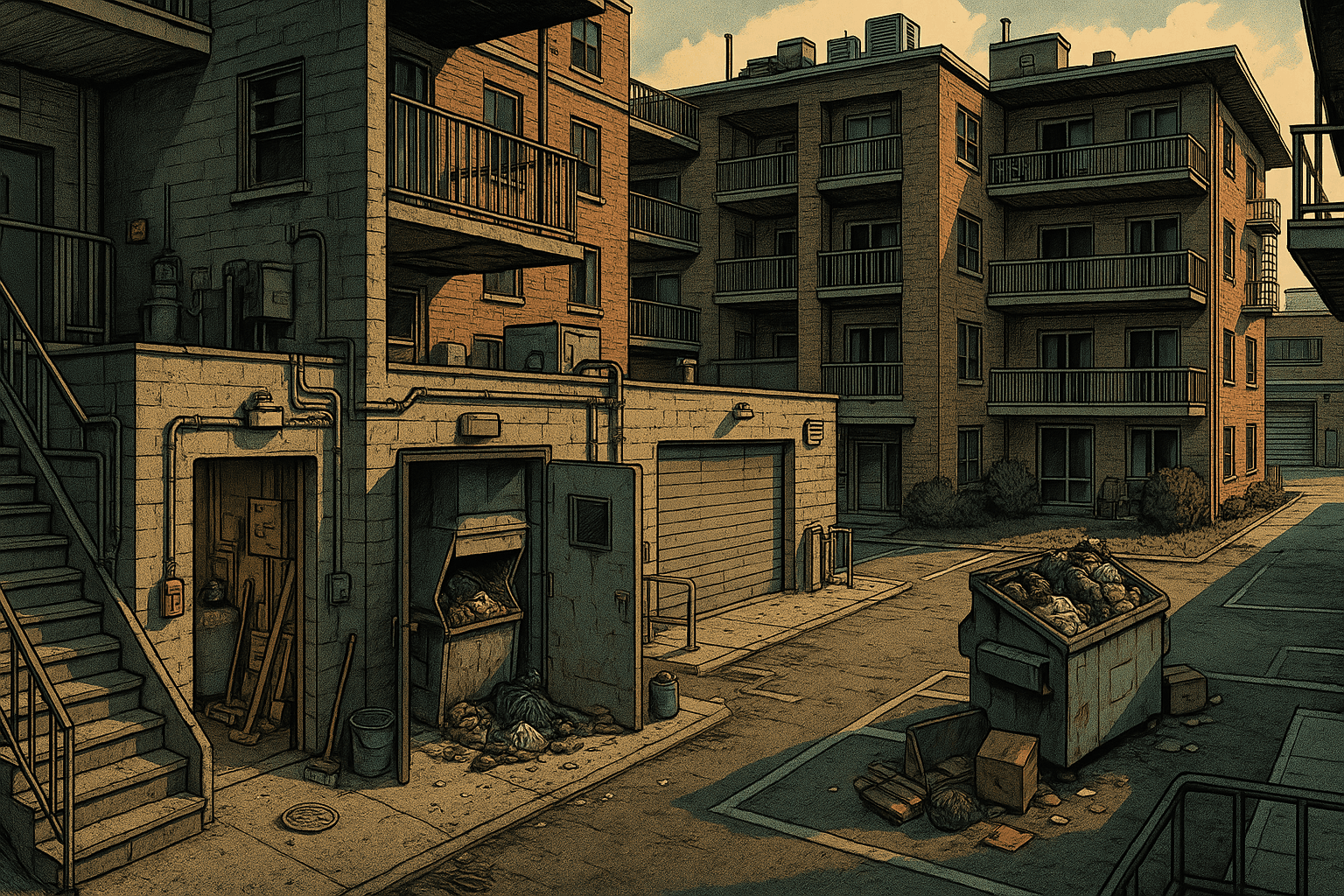
Garbage Compactor Machine Down: When Your Worst Building Nightmare Shows Up on a Tuesday
A single cardboard box brought our garbage compactor to its knees, broken ram cylinder, sleepless machine, and mounting garbage. This is what happens when equipment fails in a multi-residential building and why prevention might be harder than you think.
There are certain scenarios you know will eventually happen but still hope they don't. For me, it was a full compactor breakdown.
This morning, that hope ran out.
The Discovery
Walked into the garbage room at 7:45 a.m. and knew something was wrong immediately. The compactor was running, had been running all night, apparently, and there was a smell that told me this wasn't a minor jam.
Someone had thrown a massive cardboard box down the chute. Not broken down. Not flattened. Just shoved it in whole. The box wedged itself in a way that interfered with a sensor. The machine kept cycling, trying to compress, not registering that it should stop. By the time morning rolled around, the ram cylinder was done.
I shut the unit down manually and called the vendor at 8:02 a.m.
What Happens Next
When a compactor goes down in a building like mine, you've got maybe 24 to 48 hours before garbage becomes a serious problem. We generate a lot of waste. Normal operations keep it manageable. Take the compactor offline and you're suddenly playing catch-up.
The vendor said they'd send a tech out same-day but couldn't give me a time window. Parts might need ordering. Best case, we're back online tomorrow. Worst case, it's a few days and I'm coordinating extra bin pickups and managing overflow.
I've started staging bins in the loading area and put up a notice in the garbage room asking residents to bag everything tightly and avoid shoving large items down the chute. Not sure how much that'll help, but it's something.
The Cardboard Box Problem
Here's the thing: people don't break down boxes. I don't know why. I've posted signs. I've sent building-wide notices. I've had the maintenance worker talk to tenants he sees in the garbage room. Doesn't matter. Couple times a week, there's a pizza box, part of a bed frame, mop handles, gym equipment, chair leg, part of a tent, buckets, soap and cooking oil containers, an Amazon delivery box, or.... like today... something larger just tossed in whole.
Most of the time, the compactor handles it. Grinds through, compresses, moves on. But every once in a while, the size or shape is just wrong enough that it jams.
This one must have hit the sensor at the exact wrong angle. Machine thought it was still compressing. Kept running. Overheated the cylinder. Now we're here.
I'm not sure what the fix is. More signage feels pointless. A letter to residents might get read by ten percent of them. The reality is, you can't count on everyone to follow instructions, not saying because they're malicious, just maybe because they're busy, distracted, or genuinely don't think a cardboard box is a big deal.
So maybe the answer isn't changing tenant behavior. Maybe it's better sensors. More frequent inspections. I don't know yet.
The Ripple Effect
What makes a compactor failure especially frustrating is how quickly it cascades into other problems.
Garbage piles up. The room starts to smell. Tenants notice and call the customer service line. Work orders get logged. You start getting emails from the supervisor asking for updates. If it drags on too long, you've got potential pest issues. Complaints escalate. Everyone's day gets worse.
And meanwhile, you're still handling the regular workload, because a compactor breakdown doesn't pause the rest of the building. There's still HVAC issues, plumbing calls, routine inspections, vendor appointments. You just add "manage garbage crisis" to the list and keep moving.
I've been checking the garbage room every couple of hours today. Keeping an eye on bin levels. Making sure nothing's overflowing into the hallway. It's not hard work, but it's constant. And it eats into time I'd normally spend on other things.
Waiting on the Vendor
The tech still hasn't arrived as I'm writing this. Got a text around 1:00 p.m. saying they were running behind. Estimated arrival sometime before 4:00 p.m. That's cutting it close to the end of my shift, but I'll stay if I need to.
Once they're here, the diagnosis might take an hour. If they've got the parts on the truck, maybe we're lucky and it gets fixed today. If not, we order parts and wait. In the meantime, I'll coordinate with waste management to see if we can get an extra pickup scheduled for tomorrow morning. That'll buy some breathing room.
It's all reactive at this point. I hate reactive. I'd much rather be ahead of things. But equipment breaks. You deal with it.
What I'm Thinking About
Assuming we get through this without a major garbage disaster, I'm going to sit down and think through what changes, if any, actually make sense here.
Do I push harder on tenant education? Maybe. But I've seen enough ignored notices to know that's a long shot.
Do I lobby for a compactor upgrade with better fail-safes? Possibly. But that's a budget conversation above my pay grade, and I'm not sure it's realistic given the age of our equipment and the cost of replacements.
Do I build in more frequent inspections, say, a quick visual check of the compactor thrice a day instead of twice? That might catch early warning signs before something like this happens again. It's not foolproof, but it's something I control.
Or maybe the answer is just accepting that this will happen occasionally, and the key is having a faster response plan. Better vendor relationship. Pre-staged bins. Clearer communication process with tenants when the compactor goes offline.
I don't have the answer yet. Still in the middle of it.
The Reality of Equipment Failure
My basic response plan
When the compactor goes down, I try to move fast on the parts I can control.
- Shut down the equipment if it is unsafe to keep running.
- Call the vendor and log the time.
- Check the garbage room before overflow becomes a hallway problem.
- Put up a simple resident notice with clear instructions.
- Stage extra bins if there is space to do it safely.
- Ask about extra pickup before the room is already out of control.
- Keep management updated, even if the update is just that we are still waiting.
None of that fixes the broken machine by itself. But it keeps a bad day from turning into a building-wide mess.
If you've been doing this job long enough, you know that equipment failure isn't an "if", it's a "when." Compactors, boilers, elevators, pumps, they all break eventually. Maintenance helps. Inspections help. But nothing lasts forever, and sometimes a single wrong variable, like a cardboard box blocking the sensor at the perfect angle to cause it to run the whole night is enough to take something offline.
What separates a manageable situation from a full-blown crisis is how quickly you respond and how well you've prepared for it. I didn't prevent this breakdown, but I caught it early, contacted the vendor fast, and started managing the overflow before it became a bigger problem. That's not perfect, but it's what you've got.
The rest is waiting, coordinating, and hoping the tech shows up with the right parts.
Where Things Stand Now
Compactor's still down. Vendor's on the way. Garbage is under control for now, but that could change if this drags into tomorrow. I've updated the work order, logged everything in the system like status or any updates from the vendor, and set a reminder to check the garbage room again at 3:30 p.m.
Once the tech finishes, I'll have a better sense of timeline and next steps. Until then, it's just one of those days where the building decides to test you.
I do not think there is a grand lesson here. Equipment breaks. People ignore signs. A cardboard box becomes a mechanical problem. Then staff spend the rest of the day trying to keep the building from feeling the full impact.
This is the stressful version of the same lesson behind why the compactor room is not a magic hole. The room only works when the equipment is maintained, residents use it properly, and staff have a plan for the day it stops working.
If anyone has cracked the code on getting every resident to break down their boxes, I am still listening.
Loading reactions…
Comments
New notes are reviewed before they appear. Be kind and on-topic.
Loading comments…
Related posts
The Tested Way I Unplug a Toilet Before It Becomes a Bigger Problem
A practical superintendent field note on how I handle a plugged toilet: stop the water, use the right plunger, know when to use an auger, and avoid risky chemical shortcuts.

No, I Can't Read Your Mind: Why Reporting Building Issues Actually Matters
Building staff aren't ignoring your problems, they just don't know about them yet. Reporting an issue the moment it happens is the single most effective thing a tenant can do to get it fixed fast. Here's why that first phone call or work order makes all the difference.
What Actually Happens When You Report a Leaky Faucet
A leaky faucet sounds simple until you are the one responsible for fixing it, documenting it, finding the right part, and making sure it does not turn into water damage. This is how a small plumbing call usually goes from the superintendent side.