
What Actually Happens When You Report a Leaky Faucet
A leaky faucet sounds simple until you are the one responsible for fixing it, documenting it, finding the right part, and making sure it does not turn into water damage. This is how a small plumbing call usually goes from the superintendent side.
A dripping faucet is one of those calls that sounds small.
Sometimes it is small. Tighten this, replace that, test it, clean up, close the work order.
Other times, the tenant says "it drips a little" and you walk in to find water running under the sink, a shut-off valve that does not fully shut, and a cabinet floor already starting to swell. That is why I do not like guessing from the hallway.
You have to look at it properly.
The work order matters
The first part is not the tool bag. It is the work order.
I want the unit number, the date, what the tenant reported, and whether there is active leaking. If there is water escaping and causing damage, that jumps ahead of a slow drip. That is not being dramatic. Water can ruin flooring, cabinets, drywall, and the unit below if you leave it long enough.
A good work order also protects everyone later. If the same faucet keeps failing, the history is there. If a tenant says nobody came, the record is there. If the fixture needs replacement instead of another small repair, the pattern is there.
Documentation is boring until you need it.
First look: where is the water actually coming from?
When I get into the unit, I do not start taking things apart right away.
I run the faucet. I look under the sink. I check the handles, the base, the spout, the supply lines, and the shut-off valves. I ask the tenant when it happens. Only when hot water runs? Only when the handle is turned a certain way? All the time, even when it is off?
That tells you a lot.
A drip from the spout might be a cartridge or washer. Water around the base could be an O-ring. Water under the sink could be a supply line, drain issue, or loose connection. Low pressure might be as simple as a clogged aerator.
The repair depends on the source. Guessing wastes time.
Shut the water before you get brave
Before anything comes apart, the water gets shut off.
Under-sink valves are supposed to make this easy. Sometimes they do. Sometimes they are stiff, seized, leaking, or so old you do not trust them. If I am not confident the valve is holding, I stop and deal with that first.
There is no prize for flooding a unit because you wanted to move fast.
I put a towel or small bucket under the work area, release the pressure, and check again that the water is actually off. Then the faucet can come apart.
Parts are the real headache
People think the hard part is the repair. A lot of the time, the hard part is getting the right part.
Moen, Delta, older no-name fixtures, cartridges that look almost the same but are not, handles with hidden screws, worn stems, missing caps. If you have worked in older buildings, you know the fun.
I like to take a photo of what comes out, especially if I need to match it at a supplier. Keeping common washers, O-rings, aerators, and cartridges on hand saves a lot of trips, but you will still run into fixtures that make you shake your head.
That is building maintenance. Half skill, half detective work.
Fix it, then test it like you do not trust it
Once the part is replaced or cleaned, I reassemble everything and turn the water back on slowly.
Then I test it.
Hot. Cold. Full pressure. Low pressure. Handle on. Handle off. Look under the sink again. Dry the area, wait a minute, check for new moisture. Sometimes a leak only shows itself after pressure comes back into the line.
If it still drips, you do not just shrug and leave. You go back in and figure out what you missed.
The tenant does not care that you tried. They care that it stopped leaking.
Clean up before you leave
This part matters more than some people think.
Do not leave old washers, wet paper towel, packaging, or dirty fingerprints around the sink. Wipe the area. Put the tools away. Let the tenant know what was done and what to watch for.
If the faucet is old and likely to fail again, I note that too. Sometimes the honest answer is not another repair. Sometimes it is replacement.
A small repair is still part of a bigger system
Two simple takeaways
For tenants, the best thing you can do is report the leak early and describe what you are seeing. A slow drip, water under the sink, low pressure, or a handle that will not shut off are not the same problem. The more specific the report is, the faster the repair usually goes.
For new supers, do not let a small call make you careless. Check the source, shut the water properly, match the part, test under pressure, and leave the area clean. A faucet repair is small until it causes water damage.
A faucet call is not glamorous. Nobody writes a thank-you card because the bathroom sink stopped dripping.
But these small calls are the job. They prevent water damage, keep tenants from getting frustrated, and show whether the building is being looked after properly.
If you are a tenant, report the leak early. Do not wait until the cabinet is soaked.
This is exactly why I keep saying that reporting building issues clearly matters.
If you are a new super, slow down enough to diagnose it right. The fastest repair is the one you only have to do once.
Loading reactions…
Comments
New notes are reviewed before they appear. Be kind and on-topic.
Loading comments…
Related posts

What Is a Notice of Entry (NOE) and What It Isn't
A Notice of Entry is one of the most misunderstood documents in residential buildings. As a superintendent, I've seen tenants panic over them and others ignore them entirely, and both reactions cause problems. Here's what an NOE actually means and how it fits into the repair process.
The Tested Way I Unplug a Toilet Before It Becomes a Bigger Problem
A practical superintendent field note on how I handle a plugged toilet: stop the water, use the right plunger, know when to use an auger, and avoid risky chemical shortcuts.
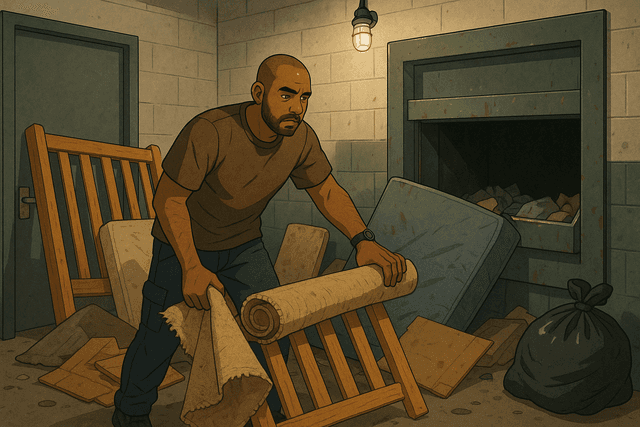
This Isn’t a Landfill
I have pulled bed frames, carpet, wood, and other nonsense out of compactor areas that were never built for that kind of abuse. Some residents truly do not know the rules. Some know and do it anyway. Either way, if nobody manages the problem, the compactor room turns into a weekly headache.